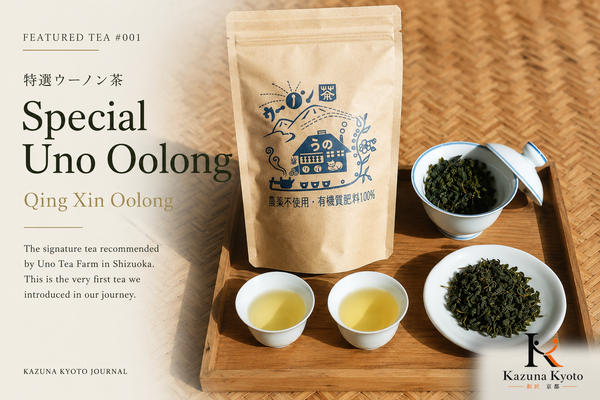
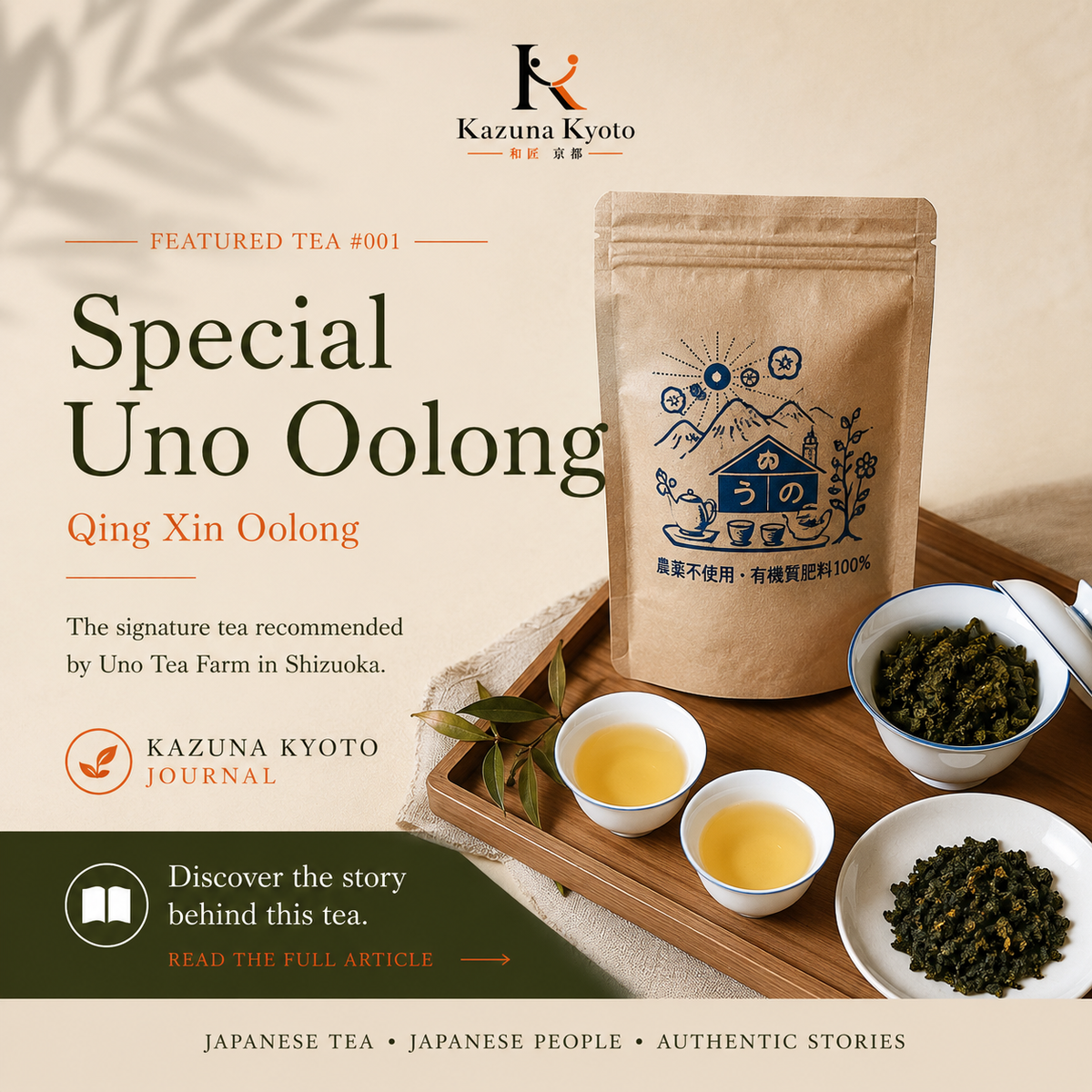
Special Uno Oolong – Qing Xin Oolong
Special Uno Oolong – Qing Xin Oolong from Uno Tea Farm introduces readers to Japanese-grown oolong tea. This guide explains what oolong is, how Japanese oolong fits within the wider tea world, and why it offers a different perspective on Japanese tea.
For many readers, Japanese tea first brings to mind sencha, matcha, hojicha, or genmaicha.
Oolong tea may feel less familiar in a Japanese context.
It is often associated with Taiwan or China, where many of the world’s best-known oolong traditions developed. Yet oolong is not limited to one country. It is a broad category of tea shaped by oxidation, processing, cultivar, place, and the choices of the producer.
Special Uno Oolong – Qing Xin Oolong from Uno Tea Farm in Shizuoka introduces another way to understand this category: Japanese-grown oolong.
What Is Oolong Tea?
Oolong is a partially oxidized tea.
In simple terms, it sits between green tea and black tea. Green tea is generally made to prevent oxidation early in processing. Black tea is fully oxidized. Oolong occupies the wide space between them.
This means oolong can vary greatly.
Some oolongs are light and close to green tea in character. Others are darker, more oxidized, and closer to black tea. The category is broad, which is part of what makes it so interesting.
For readers new to tea, it may help to think of oolong not as one fixed flavor, but as a range.
What Is Japanese Oolong Tea?
Japanese oolong tea is oolong made from tea grown in Japan.
That distinction matters.
Japan is internationally known for green tea, especially steamed green teas such as sencha. Oolong, by contrast, is still less familiar as a Japanese tea category to many international drinkers.
Japanese-grown oolong invites readers to look beyond the most familiar image of Japanese tea. It shows how Japanese producers can work with tea leaves in ways that connect to a wider tea world while still remaining rooted in Japan.
In the case of Uno Tea Farm, the tea comes from Shizuoka, one of Japan’s major tea regions.
What Makes Qing Xin Oolong Distinct?
Qing Xin Oolong is a name many tea drinkers associate with oolong.
For new readers, the important point is not to treat the name as a marketing phrase, but as a signal that this tea belongs to the oolong conversation rather than the more familiar world of Japanese green tea.
When Mr. Daisuke Uno recommended Special Uno Oolong – Qing Xin Oolong as the first tea to experience from Uno Tea Farm, it offered a clear starting point.
It was not presented as a general introduction to all Japanese tea.
It was presented as a thoughtful first step into this producer’s work.
Japanese Oolong, Taiwanese Oolong, and Chinese Oolong
It is important not to frame Japanese oolong as better or worse than Taiwanese or Chinese oolong.
They are different contexts.
Taiwanese and Chinese oolongs come from long-established oolong traditions, with their own regions, cultivars, processing styles, and cultural histories.
Japanese oolong comes from a country more widely known for green tea. That gives it a different position in the mind of many drinkers. It may feel familiar because it is Japanese tea, yet unfamiliar because it is not the Japanese tea category many people expect.
The difference is not a hierarchy.
It is a matter of origin, tradition, processing context, and interpretation.
Why This Tea Matters in the Producer Series
Kazuna Kyoto’s Producer Series begins with people.
The first article introduced Uno Tea Farm and the first conversation with Mr. Daisuke Uno. The second article introduced Special Uno Oolong – Qing Xin Oolong as a featured tea.
This third article is a guide.
Its purpose is to slow down and give readers a clearer understanding of the tea itself before moving into how to prepare it.
Japanese oolong is not only a product to taste. It is also a way to expand how we think about Japanese tea.
A Quiet Invitation
Understanding a tea begins before brewing.
It begins with knowing what kind of tea it is, where it comes from, and how it fits into a larger tradition.
Special Uno Oolong – Qing Xin Oolong offers a gentle entry into Japanese-grown oolong tea. For readers who know Japanese tea mainly through sencha or matcha, it opens a different door.
The next question is simple:
How should it be brewed?